Software asset management
Software asset management
An audit letter from Microsoft lands on a Tuesday. Legal wants your Effective Licence Position by the end of the week, and the closest thing you have is a spreadsheet nobody has opened since the last renewal. This schema exists so that question never catches you flat-footed again.
Software Asset Management (v2.0) is a Core Schema spoke: it models the full software lifecycle, from products and licence agreements through entitlements, down to individual installations on specific devices, while the master data it depends on (vendors, people, departments, cost centres) lives in Core. Compliance positions are structured for reporting, renewal dates surface before they bite, and costs flow to the departments that incur them.
What you get
| Object Type | Purpose | Key Attributes |
|---|---|---|
| Software Product | Software titles and applications | Product Name, Publisher, Category, License Model, Current Version |
| Device | Computers and servers where software is installed | Device Name, Device Type, Operating System, Department, Primary User |
| License Agreement | Software license contracts and agreements | Agreement Name, Publisher, Agreement Type, Start/End Date, Total Value, Owner |
| Entitlement | What you are licensed to use under an agreement | Agreement, Product, Quantity, Metric, Unit Cost |
| Installation | Software installations on devices | Product, Device, Version, Last Used, Discovery Source |
| Renewal | License renewal tracking | Agreement, Due Date, Notice Period (Days), Decision, Proposed Value, Owner |
| Cost Allocation | Distribution of license costs to departments | Agreement, Cost Center, Percentage, Amount, Period |
| Compliance Position | License compliance status by product | Product, Entitled Quantity, Deployed Quantity, Gap, Compliance Status |
8 object types · 12 reference types · extends Core Schema
Pro tip: Deploy Core Schema first, then link this schema to it during deployment. Your vendor records, people, departments, and cost centres then exist once, in Core, and every spoke schema shares them. Start with your three highest-spend vendors and you will have a meaningful compliance picture within a week.
What resolves to Core
Earlier versions of this schema carried their own Software Publisher and User object types. Version 2.0 drops both: publishers are Core Vendor records (the vendor's support portal URL lives on Core Vendor's Support Portal attribute), and per-user tracking points at Core Person. Seven attributes are flagged as Core references in the template:
| Attribute | Core object type | Reference type | Required |
|---|---|---|---|
| Software Product → Publisher | Vendor | Published By | Yes |
| License Agreement → Publisher | Vendor | Licensed From | Yes |
| License Agreement → Owner | Person | Owned By | No |
| Device → Primary User | Person | Assigned To | No |
| Device → Department | Department | Assigned To | No |
| Renewal → Owner | Person | Owned By | No |
| Cost Allocation → Cost Center | Cost Center | Funded By | Yes |
At deploy time, LaunchPad asks how each of these should resolve: Link to Core to point at your installed Core Schema (recommended), Create here to build the type in this schema from the bundled Core definition (a standalone fallback), or Keep as text to leave the value as free text. Linking is what makes the hub-and-spoke model pay off: one Vendor record serves your licence agreements here and your contracts in other schemas.
When to use this schema
Deploy Software Asset Management when your organisation:
-
Spends more than GBP 100,000 annually on software licences
-
Faces or expects vendor audit letters (Microsoft, Oracle, Adobe)
-
Tracks licence entitlements in spreadsheets and knows that is a risk
-
Runs discovery tools (SCCM, Intune, JAMF) and needs to correlate installations against entitlements
-
Manages multiple agreements with overlapping renewal dates
If your software estate is purely SaaS managed through identity providers, the Vendor Management schema may serve you better. For general IT asset management spanning hardware and networks alongside software, look at the Standard CMDB or Enterprise IT CMDB. For a lightweight inventory without compliance calculations, Core Schema or Basic CMDB will do.
Schema at a glance
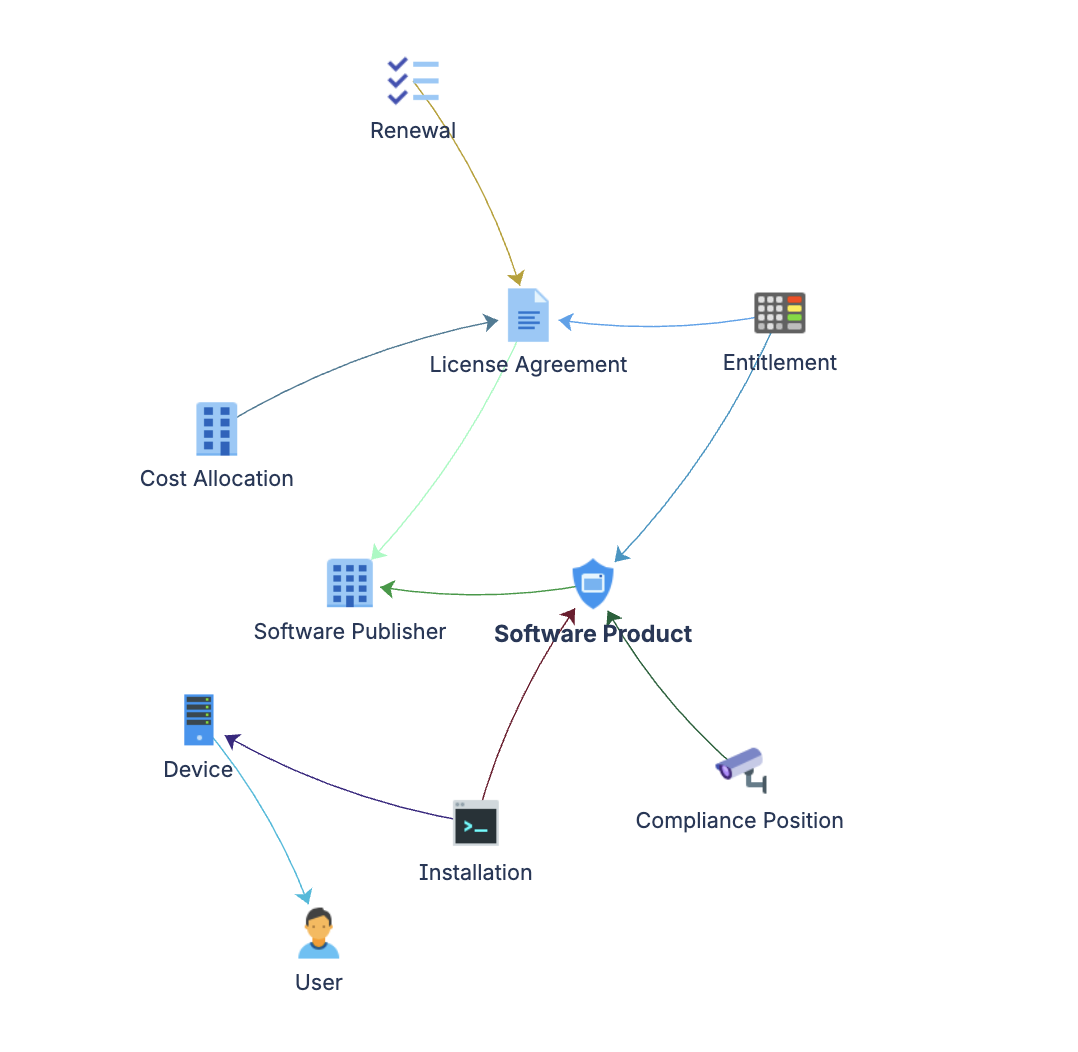
        Core Schema (Vendor · Person · Department · Cost Center)
            ▲                ▲                ▲
            │ Published By / │ Assigned To /  │ Funded By
            │ Licensed From  │ Owned By       │
            │                │                │
Software Product      License Agreement      Cost Allocation
     ▲    ▲                │       ▲
     │    └── Entitlement ─┘       └── Renewal
     │           (Covers · Entitled Under · Renewal Of · Allocated From)
     │
Installation ──(Installed On)──▶ Device
     │
Compliance Position ──(Assessed For)──▶ Software Product
Documentation
Quick Start Guide Deployment guide covering the full software lifecycle chain, from Core vendor linkage and products through to installations, compliance positions, and vendor audit preparation.
Governance Playbook (part of LaunchPad IP) Licence compliance review practices, renewal management cadence, and cost optimisation guidance.
Forms Specification (part of LaunchPad IP) Form layouts for all eight software asset management object types.